An AI SDR is software that does the job of a sales development rep: it researches leads, writes and sends outreach, handles the replies and books meetings for a human seller to run. Most products charge per contact or per month, and the reply and booking stages are where the meetings actually come from.
SDR stands for sales development representative, the person who books first meetings so account executives can spend their day selling. An AI SDR takes that job and hands it to software. Vendors pitch it as one hire that does everything.
In practice the job breaks into five stages, and they don't all need automating. This guide walks through each stage, what it costs, where it goes wrong, and when AI on the reply side alone is enough.
Revbound handles replies and booking for your existing sequencer.
Try it free for 3 days3 days free, every featureWhat is an AI SDR?
An AI SDR (AI sales development representative) is an AI agent that runs top-of-funnel outbound on its own: it finds people who fit your ideal customer profile, writes to them, follows up, reads what they reply and books a meeting on a rep's calendar when someone is interested. A human seller takes over from the meeting onward.
Most AI SDRs let you pick how much control to give away. Salesforge sells Agent Frank with auto-pilot and co-pilot modes. Artisan says its agent Ava is autonomous by default, with an option to approve messages before they go out.
AI SDR vs AI BDR
AI BDR stands for AI business development representative. For software, the two labels describe the same product. Artisan calls Ava "the AI BDR", while AiSDR and Reply.io say AI SDR, and both kinds research, write, send, reply and book.
The difference comes from the human job titles. In many sales teams a BDR works net-new outbound, writing to people who never asked to hear from you. An SDR often covers inbound leads too, following up with people who filled in a form. Vendors pick whichever word their buyers use, so judge each product by what it does at each stage.
What an AI SDR does, step by step
Every AI SDR on the market splits into the same five stages. Knowing which stage you're weakest at tells you what to buy.
Step 1 Research leads
The agent builds a list of people who match your ideal customer profile, then reads up on each account. Products ship with big contact databases for this: AiSDR lists 2B+ profiles with enrichment from 20 data providers, and Artisan includes 250M+ verified B2B contacts on every plan.
This is the stage most AI SDRs are strongest at, because it was already software (data providers and enrichment tools) before the agent arrived.
Step 2 Write
The agent writes a first email and the follow ups, personalized from the research: a recent hire, a funding round, a line from the company's site. Good products let you lock the tone and banned phrases. Artisan, for example, lets you lock tone and calls to action and set phrases Ava must never use.
If you already write your own cold email sequence and it gets replies, this stage may not need replacing at all.
Step 3 Send
Sending is where AI SDRs meet deliverability. The agent sends from your mailboxes, in your reps' names, from your own domains in Artisan's case. New domains need warming first. Salesforge says new email infrastructure takes two weeks to warm up before Agent Frank starts sending.
Agencies and teams that already send with Instantly, Smartlead or Email Bison have usually solved this stage. Swapping a working sender for an all-in-one agent means rebuilding domains, warmup and sending limits from scratch.
Step 4 Handle replies
Replies are where outbound either becomes pipeline or dies in an inbox. The agent has to read each reply and work out what the person meant: interested, asking for a meeting, out of office, pointing to a colleague, or a no. Then it answers in the same thread.
Speed matters here. AiSDR's pricing page promises replies in 5-10 min or a co-pilot mode where a person approves them. A reply answered the next morning lands after the lead has moved on, which is why following up on a warm reply is a different job from following up on silence.
Step 5 Book meetings
When a lead says yes, the agent offers times that are actually free on a rep's calendar and books the one the lead picks. Artisan lists autonomous replies and meeting booking on every plan, and Salesforge describes Agent Frank as covering everything from the first email to booking a meeting.
The meeting is the handoff. From here a human runs the call, and the AI SDR's job is done.
What does an AI SDR cost?
AI SDR prices fall into three models: per person contacted, a flat monthly fee for a block of contacts, or a quote from sales. These are the published prices on each vendor's own pricing page.
| Product | Pricing model | Published price |
|---|---|---|
| AiSDR | Pay as you go, charged daily | $1.50 per person prospected |
| Reply.io Jason AI | Monthly plan | From $500 a month |
| Salesforge Agent Frank | Per active contact | $499 a month for 1,000 active contacts |
| Artisan (Ava) | Quote by volume (about 2,500 or 6,000 leads a month) | Not published, talk to sales |
| 11x (Alice) | Demo first | Not published |
Prices from each vendor's own pricing page. They change often, so treat them as about right and check before you buy.
Two costs sit outside the sticker price. The first is contract length: AiSDR's Team plans are billed monthly with quarterly contracts. The second is setup time, such as the two weeks of warmup before a new sending domain is ready.
Per-contact pricing also means cost tracks volume, not results. At $1.50 per person, a list of 1,000 prospects costs about $1,500 before anyone replies.
Already sending cold email? You might only need the last two stages. Revbound handles replies and booking for your existing sequencer.
Try it free for 3 daysWhere do AI SDRs fall short?
The demos show the happy path. These are the gaps buyers run into after setup.
Your data decides the output
An agent that personalizes from stale or wrong data writes confident emails to the wrong people. Every stage downstream inherits the mistake, and it shows up as low reply rates that look like a copy problem.
Your domain takes the risk
The agent sends from your mailboxes. If it sends too much too soon, or to unverified addresses, your domains land in spam and your human reps suffer too. That's why vendors build warmup into setup.
Autonomy cuts both ways
An agent answering replies on its own can misread sarcasm, promise something you don't offer, or keep pitching a person who asked to be removed. Approval or co-pilot modes reduce this, but then a human is back in the loop and some of the saving goes with it.
It replaces tools you already pay for
Most AI SDRs bundle their own data, writer and sender. For a team that already has a list source, a working sequence and a warmed sender, that means paying twice for stages one to three, or tearing down a setup that works.
It stops at the meeting
An AI SDR books the call. It doesn't run it, qualify budget on a live conversation or close the deal. Even vendors say so: on its own FAQ, Salesforge answers "Will it replace my sales team?" with "The short answer is no."
Full AI SDR vs AI on the reply side only
A better question than "do we need an AI SDR?" is "at which stage are we losing meetings?" Look at where your outbound breaks.
| Full AI SDR | Reply-side AI only | |
|---|---|---|
| Best for | Teams with no outbound yet and no one to run it | Teams and agencies already sending cold email that gets replies |
| Stages covered | All five, from research to booking | Stage 4 (replies) and stage 5 (booking) |
| Your current sender | Usually replaced by the agent's own | Kept as it is |
| Setup | New data, copy, domains and warmup | Connect the sequencer and calendar |
| Pricing model | Per contact or from about $500 a month | Flat monthly plan |
If you have no outbound at all, a full AI SDR can stand one up quickly. If you already send and the replies sit unanswered for hours, the problem is stages four and five, and automating the whole pipeline won't fix it faster than fixing those two.
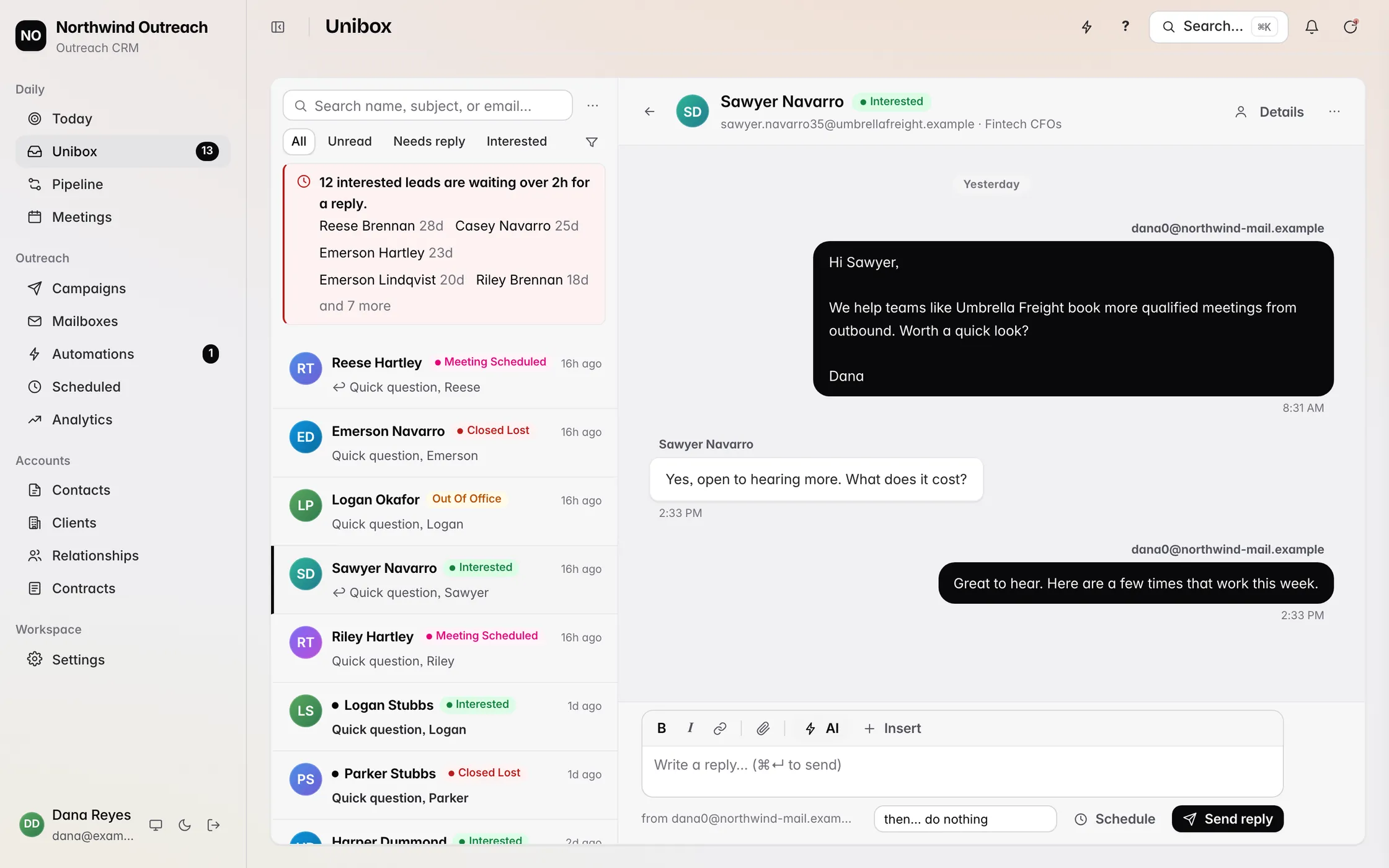
Revbound works on that reply side only. It pulls replies from Instantly, Smartlead, Email Bison, PlusVibe, SendKit and ArcSend into one inbox, sorts each one with AI (interested, meeting requested, out of office, referral, not interested), and drafts the answer or sends it. On Agency and up it answers interested leads within 5 minutes. It offers times that are free on your Cal.com or Google Calendar and books the meeting when the lead says yes.
It also writes back to out-of-office leads when they return, contacts the colleague a lead points you to, and keeps following up for about two months. It does not find leads, write your sequence or send cold email, and it has no LinkedIn, voice or CRM sync. Plans start at $49 a month on the Revbound pricing page. To compare products that cover all five stages, see our ranking of the best AI SDR software, and if you still need a sender, the best cold email software for agencies.
Summary table
| Stage | What the AI does | What to check before you buy |
|---|---|---|
| 1. Research leads | Builds and enriches a list that fits your customer profile | Data freshness and whether you already pay for a list source |
| 2. Write | Drafts the first email and follow ups from the research | Tone controls, banned phrases, approval before sending |
| 3. Send | Sends from your mailboxes and domains | Warmup time and whether it replaces a sender that already works |
| 4. Handle replies | Reads intent and answers in the thread | How fast it answers and how it handles out of office and referral replies |
| 5. Book meetings | Offers free calendar slots and books the meeting | Which calendars it connects and who gets the booking |
Stages follow the jobs an SDR does before handing a meeting to a seller.
FAQ
What is an AI SDR?
An AI SDR is software that does the work of a sales development representative. It researches leads, writes and sends outreach, reads the replies, answers them and books meetings on a rep's calendar. A human seller takes over once the meeting is booked.
What does AI BDR stand for?
AI BDR stands for AI business development representative. For software it means the same thing as an AI SDR: an agent that prospects, writes, sends, replies and books meetings. Vendors use whichever title their buyers use, so compare products by what they automate.
How much does an AI SDR cost?
Published prices range from $1.50 per person prospected on AiSDR's pay as you go plan to about $500 a month for Reply.io's Jason AI and $499 a month for 1,000 active contacts on Salesforge's Agent Frank. Artisan and 11x don't publish prices and quote through sales.
Is AI replacing SDRs?
Not fully. AI SDRs take over the repetitive parts of the job: list building, first drafts, follow ups and simple replies. People still run the meetings, handle unusual objections and close deals, and even vendors such as Salesforge say their agent works alongside a sales team rather than replacing it.
How can AI be used in sales?
AI is used in sales to research and enrich lead lists, write personalized outreach, sort incoming replies by intent, answer routine questions, offer meeting times and book calls. Teams can automate one stage, such as reply handling, without automating the whole process.
What does it mean to build AI agents?
Building an AI agent means setting up software that takes a goal, decides the next step and acts on its own, such as reading a reply and sending an answer. In sales, an AI SDR is an agent built around one goal: booking qualified meetings.
What are 5 benefits of AI in sales development?
First, replies get answered in minutes instead of hours. Second, follow ups don't get forgotten. Third, list research runs without a person. Fourth, every reply is sorted by intent. Fifth, reps spend their time on meetings instead of the inbox.
Related reading
- Buyer's guideBest AI SDR software, ranked
- GuideHow to build a cold email sequence
- Blog postOut of office reply examples